
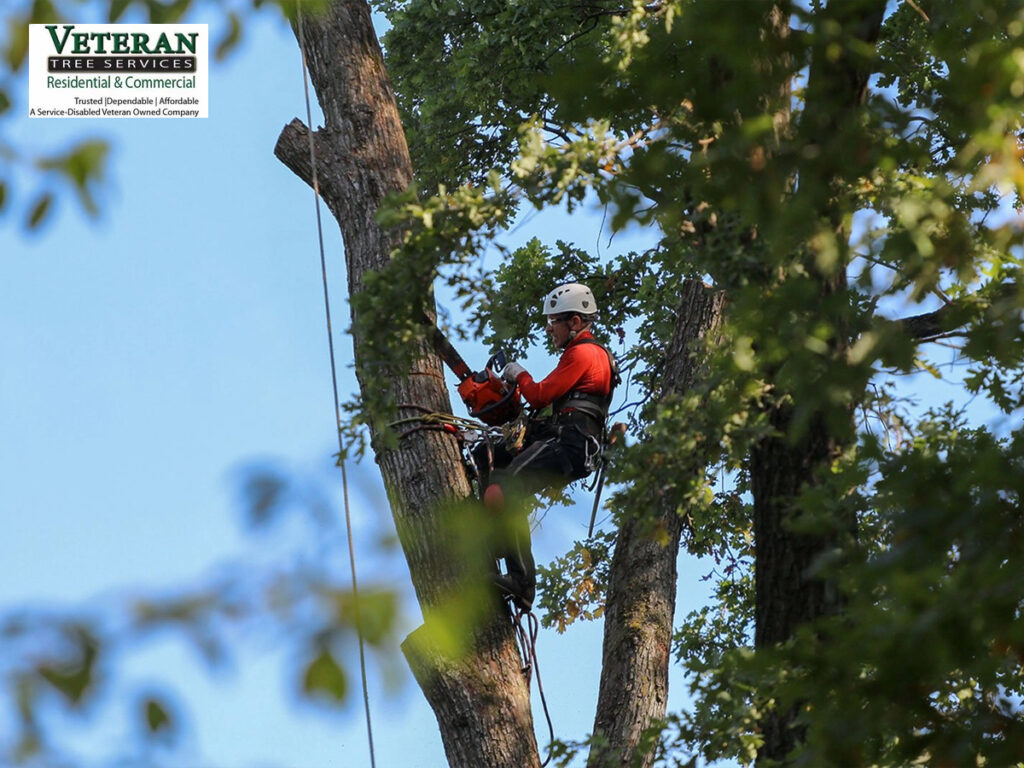
Tree removal in Northern Virginia often feels like a task people delay until a tree looks completely lifeless and begins with a quiet question: Why does a living, leaning tree feel more threatening than one that is already dead?
That unease is justified. A lean signals active imbalance, hidden stress, and stored energy waiting to release. Understanding why this condition escalates risk helps clarify when intervention becomes urgent rather than optional.
What Makes A Leaning Tree Structurally Unstable?
A leaning tree is responding to unequal forces. Soil displacement, root plate failure, or asymmetric canopy growth shifts the center of gravity away from the trunk’s base. Unlike dead trees, which have already lost physiological function, a leaning tree is still growing—often in the wrong direction. That growth compounds instability over time.
From an arboricultural standpoint, this ongoing movement strains load-bearing fibers and compresses root anchorage. Crews from veteran tree service assessments often find micro-fractures forming before any visible crack appears. The danger increases gradually, making delay a costly decision rather than a neutral one.
Why Does “Living” Not Mean “Safe” For Trees?
Living tissue masks structural failure. Sap flow and foliage density can create a false sense of security, even as internal wood fibers are failing. A dead tree tends to deteriorate uniformly, but a leaning live tree fails unpredictably. Its weight distribution changes with wind load, rain saturation, and seasonal growth cycles.
Professionals involved in tree service in Montgomery County, MD, routinely document higher incident rates from live-lean failures than from standing deadwood. The tree’s vitality keeps it heavy, flexible, and reactive—three traits that increase kinetic impact when failure occurs.
How Do Soil And Roots Amplify The Danger?
Roots are engineered for vertical balance, not lateral correction. When soil shears or erodes on one side, roots on the opposite side overcompensate. This creates tension zones underground that are impossible to inspect without specialized methods. A leaning tree may appear stable for years, then fail suddenly after heavy rain.
This is why tree removal in northern Virginia planning emphasizes subsurface conditions. Clay compaction, slope gradients, and moisture retention all accelerate root plate collapse. Dead trees rarely exert the same underground stress because their root systems are no longer actively resisting gravity.
Why Do Leaning Trees Fail Without Warning?
Dead trees usually announce their decline through decay, bark loss, or limb drop. Leaning trees fail silently. Internal compression wood forms rapidly, but it is weaker than normal growth rings. When wind torque exceeds that compromised strength, failure is abrupt.
Teams specializing in veteran tree service evaluations prioritize lean angle changes over canopy appearance. A shift of just a few degrees can signal exponential risk. Unlike dead trees, which deteriorate linearly, leaning trees reach a tipping point—literally and mechanically.
Are Weather Events More Dangerous For Leaning Trees?
Yes, because the weather multiplies the existing imbalance. Wind direction aligns with the lean, rain saturates soil, and ice loads increase crown weight. Each factor stacks force onto an already stressed structure. A dead tree may snap, but a leaning tree uproots, causing wider ground disturbance and collateral damage.
In regions served by tree service in Montgomery County, MD, storm-related failures disproportionately involve leaning live trees. Their flexibility allows force accumulation before release, increasing the impact radius when they finally give way.
When Does Monitoring Become A Liability?
Observation has limits. If a lean is recent, worsening, or paired with soil heaving, monitoring delays corrective action. Leaning trees rarely self-correct; they adapt in ways that increase mass and leverage. Waiting often converts a manageable removal into an emergency response.
Professionals handling tree removal in northern Virginia recommend proactive decisions once the lean exceeds safe thresholds. Early removal is controlled, predictable, and safer than reactive cleanup after failure.
Key warning indicators include:
- Sudden lean after storms
- Cracked or raised soil at the base
- One-sided canopy overextension
Why is Early Action Safer Than Waiting?
Waiting allows problems to compound. Leaning trees do not correct themselves. They continue shifting until failure occurs.
Early intervention gives control. Removal or correction can be planned safely. Waiting forces emergency decisions.
Professional assessments reduce risk and stress. Safety improves when action happens before collapse.
How Does Prevention Reduce Long-Term Risk?
Routine inspection catches early lean. Small adjustments prevent large failures. Healthy landscapes depend on balance, not appearance.
Prevention protects people, property, and surrounding trees. One unstable tree can damage others when it falls.
Long-term safety depends on awareness and timely care…
Conclusion: Why Early Action Matters More Than Appearances
Tree removal in Northern Virginia becomes essential when leaning trees begin to threaten safety, long before they appear dead. Leaning trees fail quietly, unpredictably… and often violently.
Understanding their hidden danger allows proactive decisions instead of reactive emergencies. Protecting landscapes means respecting early warning signs. That commitment to safety defines the approach of Veteran Tree Services.
Frequently Asked Questions
Professional Tree Risk Solutions You Can Rely On
When structural risk is uncertain, decisive evaluation matters. Veteran Tree Services delivers precision-based inspections, risk mitigation, and safe removals using industry-standard practices. If a leaning tree is raising concerns, schedule an expert assessment today.
Act Before Gravity Decides. Call on (301) 335-5143 today for professional tree safety guidance